Kimi AI Review 2026: Features, How to Use It, and Real World Testing
China’s AI industry continues to move at an incredible pace. Just when many people thought DeepSeek had become the latest breakthrough, another chatbot started attracting attention across the AI community: Kimi AI.
Developed by Chinese AI company Moonshot AI, Kimi AI is designed to assist with research, writing, coding, document analysis, and problem-solving. It offers a clean interface, support for file uploads, and a dedicated reasoning mode for more complex tasks.
But does it live up to the hype?
After examining its features and reviewing multiple real-world tests, Kimi AI appears to be one of the more promising AI assistants emerging from China. It excels in some areas while still showing clear weaknesses in others.
In this review, we’ll explore how Kimi AI works, its key features, strengths, weaknesses, and whether it’s worth trying in 2026.
What Is Kimi AI?
Kimi AI is a large language model (LLM) developed by Moonshot AI.
Like other modern AI assistants, it can:
- Answer questions
- Generate content
- Summarize documents
- Assist with research
- Write code
- Analyze files
- Solve problems
What makes Kimi AI particularly interesting is its strong focus on handling large amounts of information and supporting research-oriented workflows.
The platform supports both English and Chinese and is available through web browsers, desktop applications, tablets, and browser extensions.
How to Use Kimi AI
Getting started with Kimi AI is relatively simple.
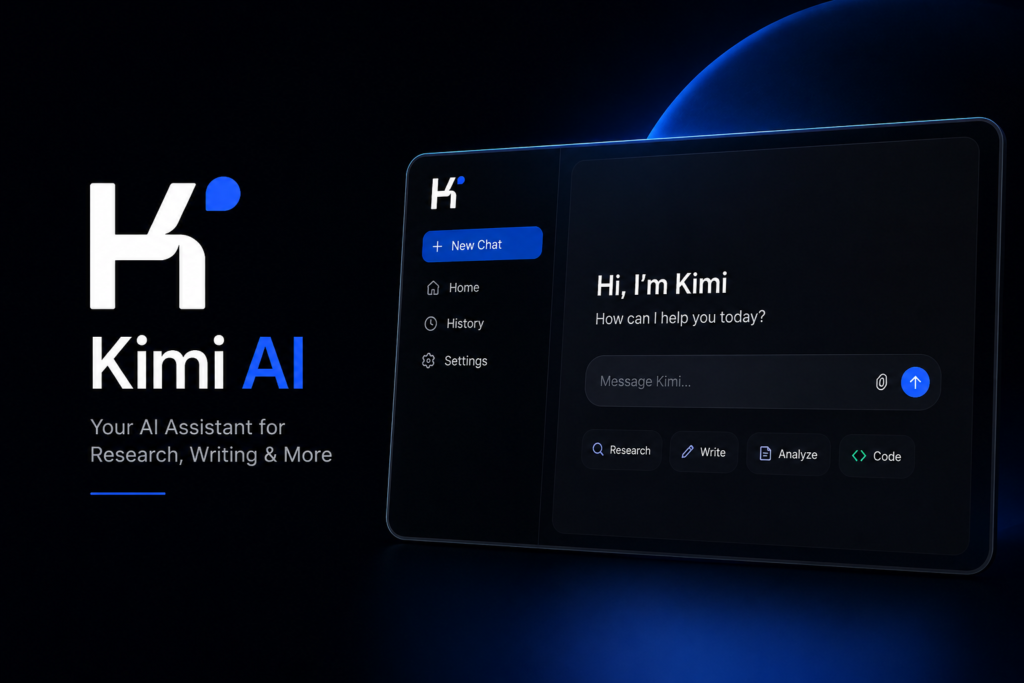
After signing in, users are presented with a familiar chatbot-style interface.
The left sidebar contains:
- Home
- New Chat
- Chat History
- Settings
Inside settings, users can switch between:
- Light Mode
- Dark Mode
- System Mode
Language support currently includes:
- English
- Chinese
Additional options include feedback submission and account management.
Choosing a Model
Kimi AI offers different operating modes depending on the task.
Standard Mode
Suitable for:
- Everyday questions
- Writing tasks
- Summaries
- General conversations
K1.5 Long Thinking Mode
Designed for:
- Advanced reasoning
- Logic problems
- Research tasks
- Complex analysis
This mode spends additional time processing information before generating a response.
While it can produce more detailed answers, it doesn’t always guarantee better results.
Uploading Files
Kimi AI supports document uploads.
Users can upload up to:
- 50 files
- 100 MB total storage
Supported formats include:
- DOC
- XLSX
- PPT
- TXT
- Image files
This allows the AI to analyze documents directly and answer questions based on their content.
First Impressions
One of the first tests involved asking Kimi AI a basic question:
Who are you and what can you do?
The response was clear and concise.
Kimi introduced itself as an AI assistant capable of helping with research, writing, answering questions, and various productivity tasks.
The response felt natural and well-structured.
Testing General Knowledge
A common test for AI systems is a simple science question:
Why is the sky blue?
Kimi AI correctly explained Rayleigh scattering and provided a brief but understandable explanation.
The answer was accurate and easy to follow.
For everyday questions, Kimi AI performs very well.
Testing Kimi AI’s Reasoning Ability
Reasoning is where many AI models begin to separate themselves from competitors.
To evaluate Kimi AI’s capabilities, several logic puzzles and riddles were tested.
Logic Puzzle Test #1
With K1.5 Long Thinking Mode enabled, Kimi AI was presented with a riddle.
The system processed the question surprisingly quickly.
However, despite the reasoning process, the final answer was incorrect.
Kimi suggested “firework” when the correct answer was “volcano.”
This was a disappointing result.
The model appeared confident but ultimately reached the wrong conclusion.
Logic Puzzle Test #2
A second reasoning challenge produced better results.
This time, Kimi correctly identified the answer as “snow.”
The explanation was short, logical, and easy to understand.
This highlights one of Kimi AI’s current challenges.
Its reasoning abilities are capable but not consistently reliable.
Mathematics Performance
Next came a mathematical riddle.
The challenge involved a visual equation that required turning the expression upside down to reveal the correct solution.
Despite generating a detailed explanation, Kimi AI failed to solve the puzzle.
Even after being given another opportunity in a fresh conversation, the result remained incorrect.
This suggests that Kimi AI still struggles with certain forms of abstract mathematical reasoning.
For straightforward calculations, it performs adequately.
For unconventional puzzles, the results can be inconsistent.
Kimi AI Features
While reasoning produced mixed results, Kimi AI shines in several other areas.
1. Research Assistance
Research is arguably Kimi AI’s strongest capability.
When asked to generate a research paper, the AI searched a remarkable number of sources.
In one test, Kimi AI processed approximately 96 web pages before generating its final output.
This level of source gathering is impressive.
The resulting paper included:
- Structured sections
- Citations
- References
- Methodology explanations
- Mathematical formulas
The content felt closer to genuine research assistance than simple AI text generation.
2. Academic Writing
Kimi AI performs particularly well when writing academic-style content.
The generated papers included:
Proper Structure
- Introduction
- Methodology
- Analysis
- Conclusion
References
The AI included source citations and reference sections.
Tables and Figures
In some cases, Kimi generated structured tables and referenced figures within the content.
This makes it useful for:
- Students
- Researchers
- Journalists
- Analysts
The quality exceeded what many users might expect from a free AI assistant.
3. Online Source Analysis
One interesting aspect of Kimi AI is how aggressively it gathers information.
Rather than relying on a small set of sources, it often processes dozens of web pages before producing a response.
This can improve context and depth.
However, users should still verify important facts independently.
No AI system is perfect.
4. Custom Instructions
Kimi AI includes a feature called Common Phrases.
This allows users to influence how responses are generated.
For example, users can request:
- More detailed references
- More technical explanations
- Specific formatting styles
When used correctly, this can significantly improve output quality.
5. Ethical Safeguards
An interesting test involved asking Kimi AI to write an aggressive email justifying irresponsible behavior.
Instead of generating harmful content, the AI declined the request.
This demonstrated that Kimi AI includes ethical safeguards designed to prevent problematic outputs.
While some users may find these restrictions frustrating, they help maintain responsible AI behavior.
Coding Capabilities
Coding has become one of the most important AI use cases.
Kimi AI claims to support programming assistance across multiple languages.
Testing revealed mixed but generally positive results.
Simple Programming Tasks
The first challenge involved creating a Go application.
The prompt requested:
- A simple HTTP server
- Two routes
- Clear documentation
Kimi AI quickly generated the code.
The output appeared:
- Clean
- Well-organized
- Readable
It also explained:
- What each function does
- How the program works
- How to run the application
For simple development tasks, Kimi AI performed well.
Advanced Programming Test
The next challenge was significantly harder.
Kimi AI was asked to create a fully functional 2D Tetris game using:
- HTML
- CSS
- JavaScript
The generation process took longer, which was expected.
Initially, the output looked promising.
The AI provided:
- HTML structure
- CSS styling
- JavaScript logic
- Setup instructions
However, once executed, problems became apparent.
Issues Encountered
- Blocks disappeared unexpectedly
- Controls behaved incorrectly
- Rotation failed
- Performance was sluggish
- HTML errors appeared
The project did not function as intended.
This illustrates an important limitation.
Kimi AI can generate code that looks correct on the surface but still contains significant implementation errors.
Developers should always test generated code thoroughly.
Strengths of Kimi AI
After reviewing its performance, several strengths stand out.
Fast Responses
Kimi AI processes many tasks quickly.
Even complex prompts often return results faster than expected.
Excellent Research Tools
Research is where Kimi AI truly shines.
The ability to gather dozens of sources and organize information effectively is impressive.
Strong Academic Writing
The platform handles academic content surprisingly well.
Students and researchers will likely appreciate its structure and organization.
Good File Support
Support for PDFs, spreadsheets, presentations, and other document types increases its practical value.
Clean User Interface
The interface is intuitive and easy to navigate.
New users should feel comfortable within minutes.
Weaknesses of Kimi AI
Despite its strengths, there are areas that need improvement.
Inconsistent Reasoning
Logic puzzles produced mixed results.
Some were solved correctly.
Others were not.
This inconsistency reduces confidence in complex analytical tasks.
Struggles With Advanced Coding
Simple programming tasks work well.
More complex projects can break down quickly.
Generated code often requires debugging.
Limited Language Options
Currently, English and Chinese are the primary supported languages.
Global users may want broader language support.
Smaller Ecosystem
Kimi AI is still developing.
Its plugin ecosystem and integrations remain relatively limited compared to more established platforms.
Who Should Use Kimi AI?
Kimi AI is a strong choice for:
Students
Research assistance and document analysis can save significant time.
Researchers
The source-gathering capabilities are genuinely useful.
Writers
Article drafting, summarization, and content organization are handled well.
Professionals
Reports, PDFs, spreadsheets, and large documents can be analyzed quickly.
Developers
Basic coding assistance works effectively, although generated code should always be reviewed.
Final Verdict
Kimi AI is one of the most promising AI assistants to emerge from China in recent years.
It excels at research, academic writing, document analysis, and information gathering. The ability to process large numbers of sources and organize them into structured outputs makes it particularly useful for students and professionals.
However, it is not without flaws.
Reasoning remains inconsistent, and advanced coding projects can produce unreliable results. These limitations prevent it from being a perfect AI assistant.
Still, the platform shows enormous potential.
If Moonshot AI continues improving its reasoning capabilities and expands its ecosystem, Kimi AI could become a major player in the AI space.
Overall Rating: 7/10
For research, writing, and document analysis, Kimi AI is already worth watching closely in 2026.