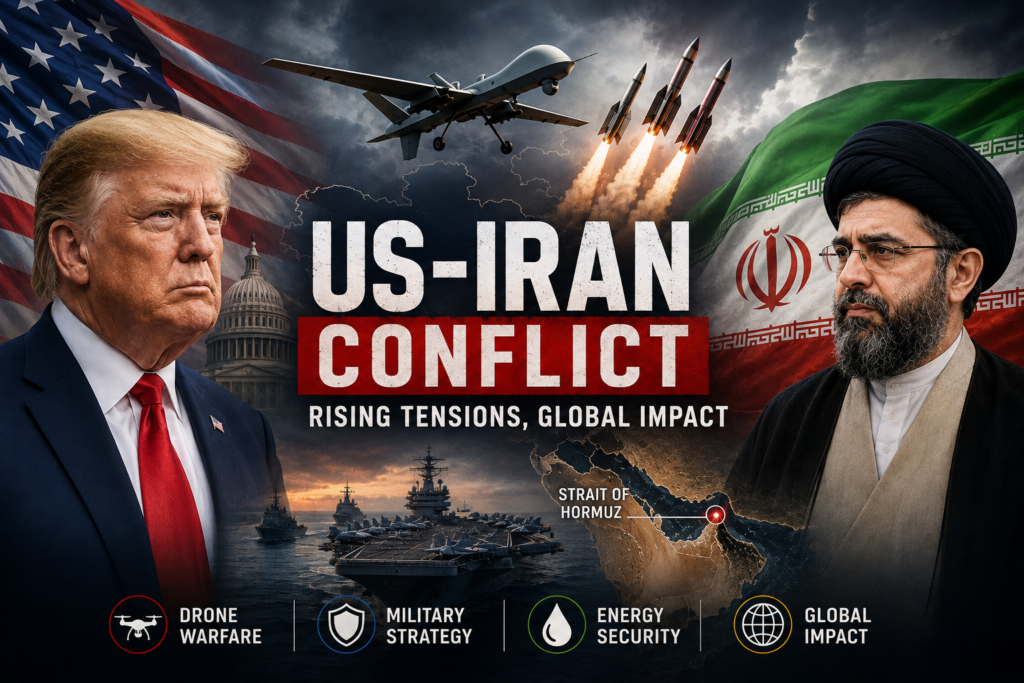
US-Iran Conflict Enters New Phase as Regional Tensions Raise Global Security Concerns
The ongoing tensions between the United States and Iran continue to draw international attention as military, economic, and geopolitical pressures reshape the balance of power across the Middle East.
While both sides have avoided a full-scale war, recent developments have highlighted how prolonged confrontations can affect regional security, military resources, and global trade routes.
Analysts say the conflict is no longer limited to direct military exchanges. It now includes economic pressure, strategic positioning, drone warfare, and competition for influence across the Middle East.
How the Conflict Has Evolved
The confrontation between the United States and Iran has intensified over the past several months.
Military operations, sanctions, and regional security concerns have remained at the center of the dispute.
Despite expectations that sustained pressure would weaken Iran’s position, reports suggest the country has continued to strengthen parts of its defense infrastructure and military production capabilities.
Security experts note that modern conflicts increasingly involve long-term endurance rather than short-term victories.
This includes maintaining supply chains, military readiness, and economic resilience.
The Growing Role of Drones in Modern Warfare
One of the biggest lessons emerging from the conflict is the increasing importance of drone technology.
Unmanned aerial vehicles have become a key component of modern military operations.
They are used for surveillance, intelligence gathering, target identification, and precision strikes.
Military analysts around the world are closely watching how drones perform in contested environments.
Recent reports have highlighted the challenges faced by advanced drone systems when operating against sophisticated air defense networks and electronic warfare capabilities.
The conflict has demonstrated that even expensive military technology can face significant risks when deployed in active combat zones.
Why Military Logistics Matter
Military planners often describe logistics as the backbone of any operation.
Maintaining aircraft, drones, ships, fuel supplies, and personnel over long periods can be extremely demanding.
The Middle East’s geography adds another layer of complexity.
Military forces operating far from home bases must depend on extensive supply networks and regional partnerships.
Any disruption to these networks can affect operational efficiency.
Experts say logistics often determine how long a military campaign can be sustained.
Strategic Importance of Regional Bases
The United States maintains military facilities and partnerships across several Middle Eastern countries.
These locations support surveillance missions, defensive operations, and regional stability efforts.
However, military bases can also become strategic pressure points during periods of heightened tension.
Security analysts note that regional governments often face difficult decisions when conflicts involve major international powers.
Balancing national interests while maintaining security partnerships can become increasingly challenging.
China and the Wider Geopolitical Picture
The US-Iran confrontation is being watched closely by other global powers.
China, in particular, has significant economic and strategic interests in the region.
The Middle East remains one of the world’s most important energy-producing regions.
Any disruption can affect global markets and international trade.
Analysts believe prolonged instability could influence strategic calculations far beyond the Middle East.
This includes developments in Asia, Europe, and other key geopolitical regions.
Taiwan Concerns Remain in Focus
Some geopolitical observers argue that major international conflicts can create opportunities elsewhere.
As global powers focus resources on one region, attention may be diverted from other strategic priorities.
Taiwan continues to be a major focus of international security discussions.
Any shift in military deployments or strategic planning is closely monitored by governments across the Indo-Pacific region.
While there is no direct connection between the two situations, policymakers often assess global security challenges as part of a broader strategic picture.
The Economic Impact of Regional Instability
The economic consequences of Middle East tensions extend far beyond the region itself.
Energy markets are particularly sensitive to geopolitical uncertainty.
Investors, businesses, and governments closely monitor developments involving oil-producing nations.
Any threat to supply routes can lead to increased market volatility.
Shipping companies, manufacturers, and importers often adjust their strategies when geopolitical risks rise.
This demonstrates how regional conflicts can have global economic effects.
Strait of Hormuz Remains a Critical Waterway
One of the most important strategic locations in the world is the Strait of Hormuz.
A significant portion of global oil exports passes through this narrow maritime corridor.
Because of its importance, any disruption in the area immediately attracts international attention.
Energy markets closely track developments involving shipping activity and maritime security in the region.
Even the possibility of disruptions can influence global oil prices.
Governments around the world therefore view stability in the Strait of Hormuz as a major priority.
Air Defense Systems Under Scrutiny
Modern warfare increasingly depends on advanced missile defense systems.
Countries invest billions of dollars in technologies designed to intercept incoming threats.
Recent military operations have renewed discussions about the effectiveness of air defense networks against large numbers of drones and missiles.
Defense experts argue that future conflicts may involve a combination of traditional missiles, drones, cyber capabilities, and electronic warfare systems.
As a result, military planners continue to evaluate how best to adapt to changing threats.
The Cost of Advanced Military Technology
Modern defense systems require enormous financial investment.
Fighter aircraft, missile defense batteries, surveillance platforms, and advanced drones can cost billions of dollars to develop and maintain.
When conflicts continue for extended periods, replacement costs become a major consideration.
Governments must balance military requirements with broader economic priorities.
This challenge affects countries across the world regardless of their military strength.
The conflict has renewed discussions about the long-term sustainability of high-cost military operations.
Diplomacy Still Plays a Central Role
Despite ongoing tensions, diplomacy remains one of the most important tools for preventing escalation.
International organizations and regional partners continue to encourage dialogue between competing sides.
History shows that military pressure alone rarely resolves complex geopolitical disputes.
Long-term stability often requires diplomatic engagement, economic cooperation, and confidence-building measures.
Many analysts believe future progress will depend on a combination of security arrangements and diplomatic efforts.
What Happens Next?
The future of US-Iran relations remains uncertain.
Military activity, regional alliances, economic pressures, and diplomatic negotiations will all influence the next phase of the conflict.
Governments across the world are closely monitoring developments.
The outcome could affect energy markets, regional security, international trade, and broader geopolitical dynamics.
For now, both sides appear focused on protecting their interests while avoiding a larger regional confrontation.
However, the situation remains fluid.
Any major development could quickly reshape the strategic landscape of the Middle East.
Conclusion
The US-Iran conflict has become one of the most closely watched geopolitical issues in the world.
It highlights the growing importance of drones, missile defense systems, economic resilience, and strategic partnerships.
At the same time, it underscores how regional disputes can have global consequences.
From energy security to international trade and military planning, the effects are felt far beyond the Middle East.
As tensions continue, policymakers, businesses, and security experts will be watching closely for signs of either escalation or renewed diplomatic engagement.