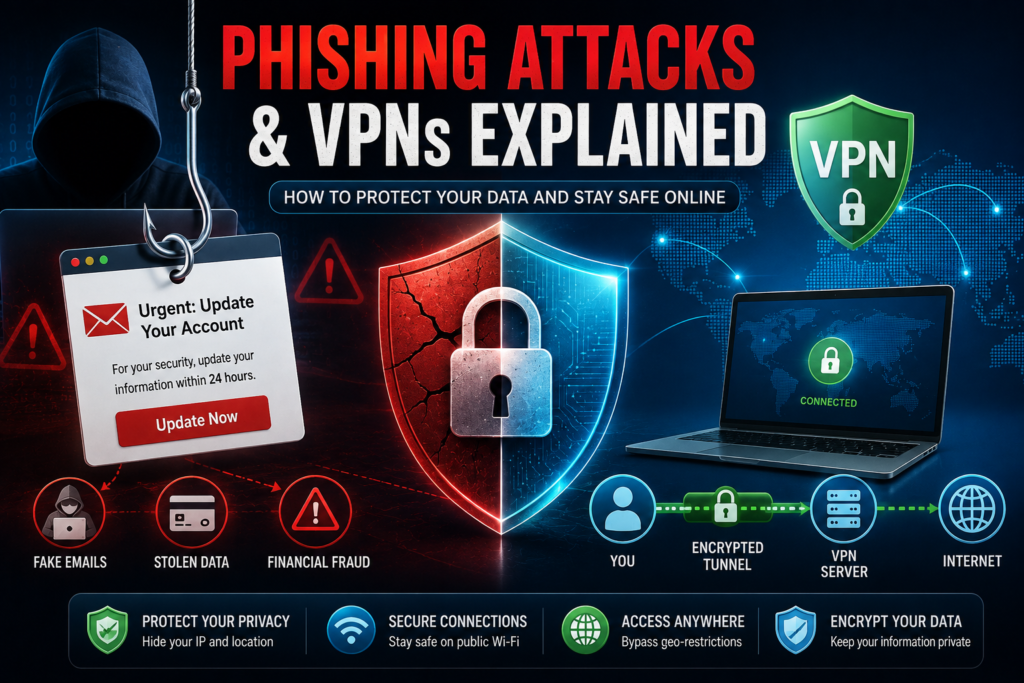
Phishing Attacks and VPNs Explained: How to Protect Your Data and Stay Safe Online
The internet has made communication, banking, shopping, and work easier than ever. However, it has also created new opportunities for cybercriminals.
Two of the most important cybersecurity topics today are phishing attacks and Virtual Private Networks (VPNs). Understanding both can help individuals and businesses protect sensitive information from online threats.
Cyberattacks continue to rise worldwide. As more people work remotely and spend hours online every day, awareness has become one of the strongest defenses against digital threats.
What Is Phishing?
Phishing is a form of cybercrime that tricks people into revealing sensitive information.
Attackers typically pretend to be trusted organizations such as banks, streaming services, online stores, or government agencies. Their goal is to convince victims to share passwords, credit card numbers, banking details, or other private information.
The term phishing comes from the concept of fishing.
Cybercriminals cast a wide net and hope that someone takes the bait.
How a Typical Phishing Attack Works
Imagine receiving an email claiming to be from your bank.
The message says your account is at risk and you must update your PIN within 24 hours.
The email includes a link that appears legitimate.
After clicking the link, you are taken to a website that looks identical to your bank’s official website.
You enter your details and submit the form.
However, the website is fake.
Instead of updating your information, the data is sent directly to the attacker.
Within hours, unauthorized transactions may appear on your account.
This is one of the most common phishing scenarios seen today.
Why Phishing Is So Effective
Phishing attacks rely on human psychology rather than technical vulnerabilities.
Attackers create a sense of urgency.
They may claim your account will be suspended, your payment failed, or your security is at risk.
When people feel pressured, they are more likely to act without carefully checking the message.
Cybercriminals know this.
That is why phishing remains one of the most successful forms of cybercrime worldwide.
Different Types of Phishing Attacks
Not all phishing attacks work the same way.
Several techniques are commonly used by cybercriminals.
Deceptive Phishing
This is the most common type of phishing attack.
Attackers send the same fraudulent message to thousands of people.
Only a small percentage of recipients need to fall for the scam for the attack to be profitable.
Spear Phishing
Spear phishing is more targeted.
Attackers research their victims before sending messages.
For example, if someone frequently uses Spotify, attackers may create fake Spotify emails designed specifically for that person.
Because the message feels more relevant, the chances of success increase.
Whaling
Whaling targets high-profile individuals.
These may include CEOs, executives, politicians, or wealthy individuals.
The preparation is often extensive.
The goal may involve stealing corporate secrets, financial information, or strategic business data.
Smishing
Smishing is phishing conducted through text messages.
Instead of email, attackers use SMS messages to trick victims into clicking malicious links or revealing sensitive information.
Pharming
Pharming involves fake websites that closely resemble legitimate ones.
Attackers often register domain names that look almost identical to trusted websites.
A small spelling difference may be enough to trick users into entering sensitive information.
Real-World Impact of Phishing
Phishing is not limited to individual victims.
Large organizations have also suffered major losses.
Even some of the world’s biggest technology companies have fallen victim to sophisticated phishing campaigns.
These incidents demonstrate that no organization is completely immune to social engineering attacks.
Beyond stolen credentials, phishing attacks can also install malware.
In some cases, attackers use malicious links to deploy ransomware or gain long-term access to victim devices.
How to Protect Yourself from Phishing
The good news is that preventing phishing attacks is often straightforward.
Verify Email Authenticity
Always inspect emails carefully.
Check the sender’s address and verify that it belongs to the organization it claims to represent.
Inspect Links Before Clicking
Hover over links before opening them.
Look for suspicious domain names or unusual web addresses.
Check for HTTPS
Legitimate websites typically use HTTPS encryption.
While HTTPS alone does not guarantee safety, it is an important security indicator.
Avoid Sharing Sensitive Information
Never enter passwords, banking information, or payment details on unfamiliar websites.
Even if a page looks authentic, verify its legitimacy first.
Use Security Tools
Modern browsers and security extensions can help identify potentially dangerous websites and emails.
Stay Alert
The most effective defense against phishing is awareness.
Cybercriminals constantly adapt their tactics.
Users who remain cautious are far less likely to become victims.
What Is a VPN?
A VPN, or Virtual Private Network, is a technology that creates a secure connection between your device and the internet.
It encrypts your internet traffic and routes it through a secure server before it reaches its final destination.
VPNs have become increasingly popular among people concerned about privacy and online security.
Why People Use VPNs
Many internet users rely on VPNs for several reasons.
Enhanced Privacy
A VPN can hide your IP address from websites.
Instead of seeing your real location, websites see the location of the VPN server.
Secure Public Wi-Fi Usage
Public Wi-Fi networks in airports, hotels, and coffee shops can be risky.
Attackers may attempt to intercept data on these networks.
A VPN encrypts your traffic, making it much harder for others to see your activity.
Bypassing Geographic Restrictions
Some online services restrict content based on location.
VPNs can help users access services available in different regions.
Protecting Sensitive Information
VPN encryption helps secure personal data as it travels across the internet.
This includes login credentials, financial information, and private communications.
How VPNs Work
When a VPN is active, your data is encrypted before leaving your device.
The encrypted data travels to the VPN provider’s server.
The server then forwards your request to the website you want to visit.
This process creates a secure tunnel between your device and the VPN provider.
Anyone attempting to intercept the traffic sees only encrypted data.
The Different Types of VPNs
Corporate VPNs
Many companies use VPNs to allow employees secure access to internal systems.
These VPNs focus on protecting company resources rather than personal privacy.
Third-Party VPNs
These are the commercial VPN services promoted online.
Users subscribe to a provider that handles the encryption and routing of internet traffic.
Self-Hosted VPNs
Some users operate their own VPN servers.
This approach gives greater control but requires technical knowledge and infrastructure.
The Benefits of VPNs
VPNs offer several important advantages.
They can hide your IP address.
They can mask your location.
They can encrypt your internet traffic.
They can reduce exposure on public Wi-Fi networks.
For many users, these benefits provide an additional layer of online security.
The Risks and Limitations of VPNs
VPNs are useful tools, but they are not magic solutions.
You Still Need to Trust Someone
Without a VPN, you primarily trust your internet service provider.
With a VPN, much of that trust shifts to the VPN provider.
A poorly managed VPN service could collect user data or mishandle privacy protections.
Free VPNs Can Be Risky
Some free VPN providers monetize user data.
If a service is completely free, it is worth asking how the company generates revenue.
VPNs Do Not Guarantee Anonymity
Many users mistakenly believe VPNs make them completely anonymous.
This is not always true.
Websites can still identify users through browser fingerprints, tracking technologies, and account logins.
VPNs Do Not Stop Malware
A VPN cannot prevent malware infections.
Users still need good cybersecurity habits and reliable security software.
Performance May Be Slower
Because data is encrypted and routed through additional servers, VPN connections may be slower than direct internet connections.
The Connection Between Phishing and VPNs
Phishing and VPNs address different cybersecurity concerns.
Phishing focuses on stealing information through deception.
VPNs focus on protecting information while it travels across networks.
A VPN cannot stop someone from entering their password on a fake website.
Similarly, avoiding phishing attacks does not protect internet traffic from interception.
This is why cybersecurity requires multiple layers of protection.
Final Thoughts
Phishing attacks and VPNs represent two important aspects of modern cybersecurity.
Phishing attacks exploit trust and human behavior.
VPNs aim to secure internet traffic and improve privacy.
Understanding both technologies can help users make smarter decisions online.
The best defense combines awareness, secure browsing habits, strong passwords, multi-factor authentication, and trusted security tools.
As cyber threats continue to evolve, staying informed remains one of the most effective ways to protect personal and financial information.