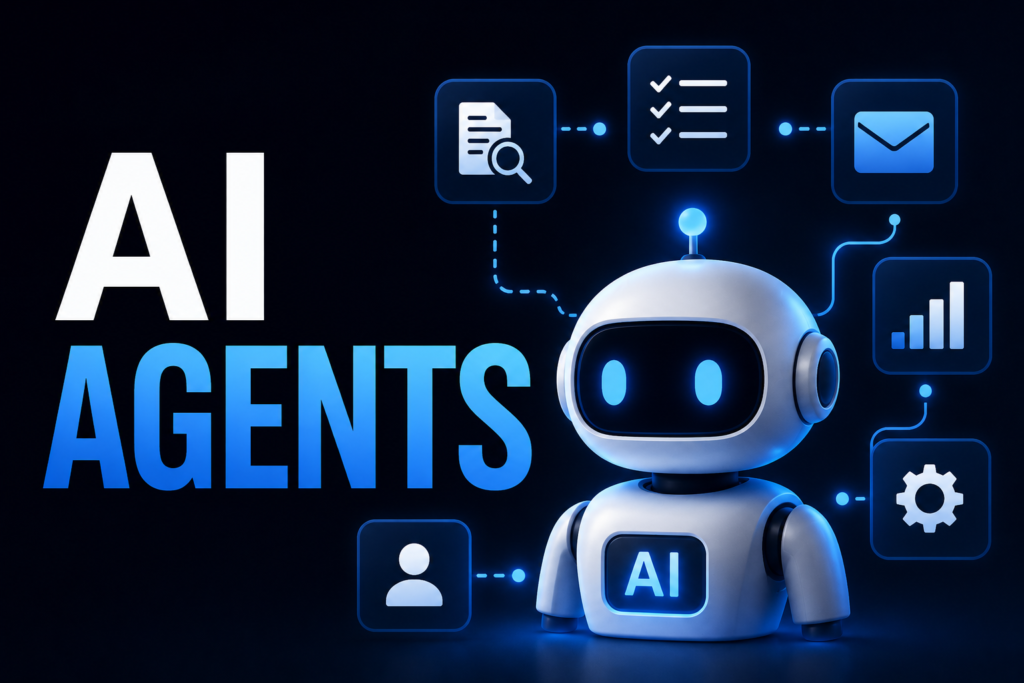
AI Agents Explained: A Beginner’s Guide to Building AI Agents in 2026
Artificial Intelligence is changing how people work. But the biggest opportunity may not be using AI chatbots. It may be building AI agents.
According to recent industry reports, AI could create millions of new jobs over the next decade. Many of those jobs will involve designing, managing, and deploying AI-powered systems.
If you have heard the term AI agent but are not sure what it means, this guide is for you.
In this article, you’ll learn:
- What an AI agent is
- How AI agents differ from chatbots
- When you should build an AI agent
- A simple framework for creating AI agents
- How businesses are already using AI agents today
- Common mistakes beginners make
Let’s get started.
What Is an AI Agent?
An AI agent is an AI system that can perform tasks with minimal human involvement.
Unlike a chatbot that waits for instructions, an AI agent can:
- Analyze information
- Make decisions
- Take actions
- Evaluate results
- Improve its process over time
Think of it this way:
Chatbot = Assistant
You ask a question.
It gives an answer.
Then it waits.
AI Agent = Employee
You give it a goal.
It figures out how to complete the work.
Then it continues operating according to its instructions.
This is why AI agents are becoming one of the hottest topics in artificial intelligence.
AI Chatbot vs AI Agent
Many people think chatbots and AI agents are the same thing.
They are not.
| AI Chatbot | AI Agent |
|---|---|
| Answers questions | Completes tasks |
| Requires constant prompts | Works toward goals |
| Stops after responding | Can continue operating |
| Mostly reactive | More proactive |
| Limited workflow automation | Can manage full workflows |
For example:
A chatbot can help you write an email.
An AI agent can:
- Read incoming emails
- Categorize them
- Draft replies
- Flag important messages
- Follow predefined rules
The difference is significant.
One gives information.
The other performs work.
The D.A.T.A Framework of AI Agents
A useful way to understand AI agents is through four core abilities.
D – Diagnose
An AI agent can identify problems.
It can analyze situations and determine what needs attention.
Think of it as a consultant.
A – Assemble
The agent can create plans.
It can organize resources and determine what steps are needed.
Think of it as an architect.
T – Take Action
This is where the work happens.
The agent executes tasks and carries out workflows.
Think of it as an operator.
A – Assess
The agent reviews outcomes.
It checks whether goals were achieved and adjusts if needed.
Think of it as a quality assurance specialist.
Why AI Agents Are Different From Automation
Traditional automation follows fixed rules.
It performs the same actions repeatedly.
AI agents are different.
They can analyze outcomes and adapt.
This creates a feedback loop.
The cycle looks like this:
- Analyze
- Act
- Evaluate
- Improve
Because of this loop, AI agents can handle more complex tasks than standard automation tools.
Should You Build an AI Agent?
Not every task needs an AI agent.
A simple rule can help.
The Three R Rule
Before building an AI agent, ask yourself these questions.
1. Is the Task Repetitive?
Do you perform it every day or every week?
Examples:
- Email management
- Customer support
- Lead qualification
- Content research
If yes, it may be a good candidate.
2. Is It Rule-Based?
Does the task follow predictable steps?
If the same input usually produces the same output, AI agents can often handle it.
Examples include:
- Sorting emails
- Categorizing support tickets
- Scheduling meetings
3. Does It Generate a Return?
Will the time saved justify building the agent?
If a task takes two minutes per month, automation may not be worth it.
If it takes two hours every day, the return could be significant.
How to Build an AI Agent
One simple framework is the AGENT Method.
Each letter represents a key step.
A – Aim for a Specific Outcome
Most beginners focus on tasks.
Successful builders focus on outcomes.
Instead of saying:
“Manage my emails.”
Say:
“I want my inbox organized every morning.”
The outcome is clear.
The AI can determine how to get there.
Define Success
Your agent needs a clear definition of success.
For example:
Every morning at 9 AM, important emails are highlighted, routine emails are categorized, and draft replies are prepared.
The clearer the target, the better the results.
G – Give It an Identity
AI performs better when it has a defined role.
Think about hiring a real employee.
You would provide:
- Job title
- Responsibilities
- Expectations
AI agents work similarly.
A strong identity helps focus behavior.
Create Three Core Files
1. Soul File
Defines behavior.
Examples:
- Friendly
- Professional
- Direct
- Concise
2. Identity File
Defines who the agent is.
Examples:
- Email Manager
- Research Assistant
- Customer Support Agent
3. User File
Defines who the agent serves.
Examples:
- Business owner
- Freelancer
- Content creator
This context helps personalize results.
E – Equip the Agent
An agent cannot work without tools and information.
This step is often overlooked.
You need to provide:
- Data
- Documentation
- Processes
- Access to relevant systems
The quality of these inputs directly affects performance.
Why Context Matters
Good context creates good outputs.
Poor context creates poor outputs.
Many AI failures happen because the system lacks sufficient information.
Think of context as fuel.
Without enough fuel, the agent cannot perform effectively.
Document Your Processes
One simple approach is recording yourself performing a task.
Then use AI to convert the recording into a step-by-step process.
Examples:
- Email handling
- Content publishing
- Customer support workflows
- Data entry tasks
The AI can then learn from these examples.
N – Narrow the Scope
One of the biggest mistakes people make is creating a giant agent that does everything.
This usually fails.
Instead, create specialized agents.
Examples:
Research Agent
Only gathers information.
Writing Agent
Only creates content.
Review Agent
Only checks quality.
Reporting Agent
Only creates reports.
Each agent focuses on a single responsibility.
This improves reliability.
The Power of Manager Agents
As your system grows, you can introduce a manager agent.
A manager agent:
- Assigns work
- Coordinates sub-agents
- Reviews progress
- Delivers final results
Think of it as a project manager.
It doesn’t perform tasks itself.
It manages the specialists.
T – Trust the Process
This is the hardest step.
Most people struggle to give AI agents real responsibility.
The solution is gradual trust.
Stage 1: Observation
Watch what the agent does.
Review everything.
Make corrections.
Stage 2: Limited Action
Allow the agent to perform low-risk tasks.
Examples:
- Sorting emails
- Drafting responses
- Categorizing information
Stage 3: Expanded Responsibility
As confidence grows, increase permissions.
The agent can handle larger portions of the workflow.
Stage 4: Full Automation
Eventually, the agent operates independently within defined boundaries.
At this point, the time savings become substantial.
Real-World AI Agent Use Cases
AI agents are already being used across industries.
Here are some common examples.
Email Management
An agent can:
- Sort messages
- Draft replies
- Prioritize important emails
- Create summaries
Customer Support
Agents can:
- Answer common questions
- Route tickets
- Escalate complex issues
Content Marketing
Agents can:
- Research topics
- Generate outlines
- Draft articles
- Review content quality
Software Development
Development agents can:
- Write code
- Analyze bugs
- Review pull requests
- Generate documentation
Research
Research agents can:
- Gather sources
- Summarize findings
- Create reports
- Track industry trends
Common Mistakes When Building AI Agents
Avoid these common errors.
Building Mega Agents
One giant agent often becomes confusing and unreliable.
Use specialized agents instead.
Providing Poor Context
Without clear instructions and examples, results suffer.
Context is everything.
Skipping Testing
Never give an agent full control immediately.
Test extensively.
Review outputs.
Improve gradually.
Unclear Goals
Vague objectives lead to inconsistent results.
Always define success clearly.
Will AI Agents Replace Jobs?
This is a common concern.
In many cases, AI agents are not replacing workers.
They are eliminating repetitive work.
This allows people to focus on:
- Strategy
- Creativity
- Problem solving
- Relationship building
The most successful professionals will likely be those who learn how to work alongside AI agents rather than compete against them.
Final Thoughts
AI agents are quickly becoming one of the most important trends in artificial intelligence.
Unlike chatbots, they can execute workflows, make decisions, and continuously improve through feedback loops.
The key steps are simple:
- Aim for a clear outcome.
- Give the agent an identity.
- Equip it with context and tools.
- Narrow its scope.
- Build trust gradually.
You do not need to be a programmer to start experimenting with AI agents.
Many modern platforms allow beginners to create useful agents with little or no code.
The biggest opportunity is not simply chatting with AI.
It is learning how to direct AI systems to perform meaningful work on your behalf.
As AI technology continues to evolve, understanding AI agents may become one of the most valuable skills of the decade.