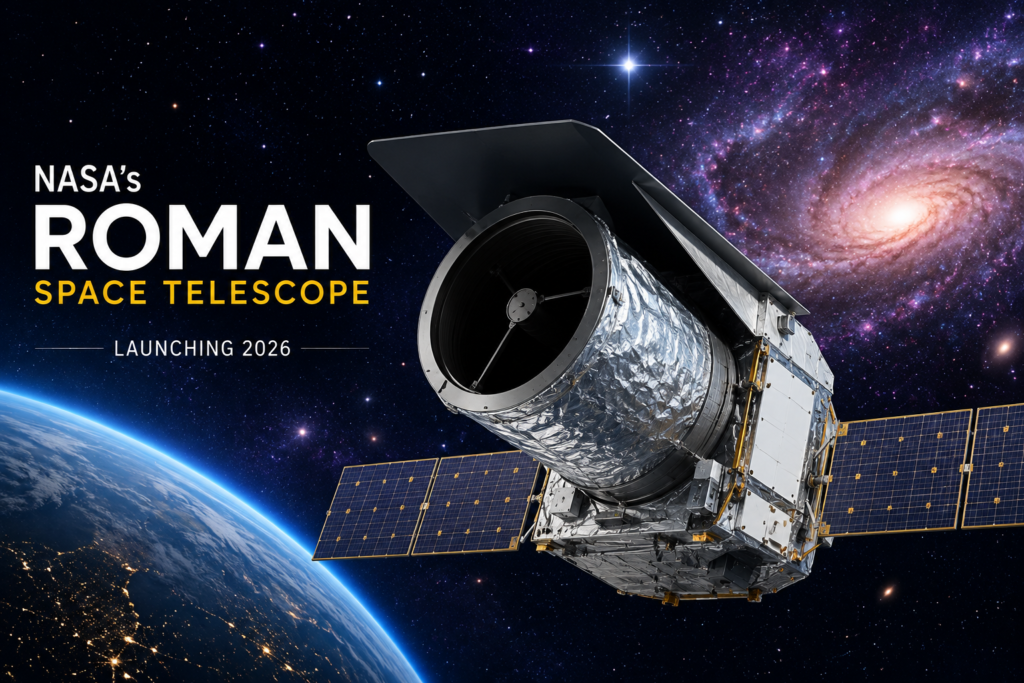
Why the Nancy Grace Roman Space Telescope Could Be NASA’s Most Important Observatory Yet
The James Webb Space Telescope has captured the world’s attention with stunning images of distant galaxies, while the Hubble Space Telescope continues to deliver valuable discoveries more than three decades after launch.
But NASA is already preparing its next major space observatory.
The Nancy Grace Roman Space Telescope, expected to launch in 2026, is designed to answer some of the biggest questions in astronomy. Scientists hope it will help explain the mysterious force known as dark energy, discover thousands of new planets beyond our solar system, and create one of the largest maps of the universe ever produced.
Although it may not receive the same level of public attention as the James Webb Space Telescope, many astronomers believe Roman could become one of NASA’s most important scientific missions of the decade.
What Is the Nancy Grace Roman Space Telescope?
The Nancy Grace Roman Space Telescope is NASA’s next flagship space observatory.
At first glance, it shares several similarities with the Hubble Space Telescope. Both telescopes use a mirror that is 2.4 meters in diameter, and both observe visible and near-infrared wavelengths of light.
However, Roman has one major advantage.
Its field of view is approximately 100 times larger than Hubble’s.
That means Roman can capture enormous areas of the sky in a single image while maintaining the same level of detail astronomers have come to expect from Hubble.
Instead of taking hundreds of individual images to study a large region of space, Roman can do much of that work in a single observation.
This capability will allow scientists to survey the universe faster and more efficiently than ever before.
Who Was Nancy Grace Roman?
The telescope is named after Nancy Grace Roman, one of the most influential astronomers in NASA’s history.
Roman earned her PhD in astronomy from the University of Chicago during the 1940s. Her research helped scientists better understand how stars are distributed throughout the Milky Way and provided important clues about how our galaxy formed.
When NASA was established in 1958, Roman joined the agency and became its first Chief of Astronomy.
Her role involved identifying important scientific projects, building support within the astronomy community, and securing funding from Congress.
One of the projects she strongly supported was the development of what would later become the Hubble Space Telescope.
Because of her efforts, she became known as the “Mother of Hubble.”
Naming NASA’s next major observatory after her is a fitting tribute to her contributions to modern astronomy.
Roman’s Mission: Solving the Mystery of Dark Energy
One of the telescope’s primary goals is studying dark energy.
Dark energy is the name scientists give to the unknown force causing the expansion of the universe to accelerate.
Even though researchers know this acceleration is happening, they still do not know what dark energy actually is.
To investigate the mystery, Roman will create an enormous three-dimensional map of the universe.
The telescope will photograph millions of galaxies across large regions of the sky. It will then analyze the light coming from those galaxies using an instrument called a spectrograph.
A spectrograph separates light into its individual wavelengths, creating what scientists call a spectrum.
By studying these spectra, astronomers can determine how much a galaxy’s light has been stretched by the expansion of the universe. This effect is known as redshift.
The greater the redshift, the farther away the galaxy is.
This information allows researchers to transform a two-dimensional image of the sky into a three-dimensional cosmic map.
Because light takes billions of years to travel across space, Roman will also show scientists how the universe looked in the distant past.
The result will be a detailed timeline of cosmic expansion that could reveal the true nature of dark energy.
Creating One of the Largest Maps of the Universe Ever Made
Roman’s wide field of view makes it ideal for large-scale surveys.
The telescope will scan huge areas of the sky and record the positions of millions of galaxies.
Scientists will use this information to study how matter is distributed throughout the universe and how cosmic structures have evolved over billions of years.
The project is expected to generate an unprecedented amount of data.
Astronomers hope this massive survey will improve our understanding of galaxy formation, dark matter, and the large-scale structure of the cosmos.
Searching for New Worlds Beyond Our Solar System
Roman is not limited to studying distant galaxies.
The telescope will also search for exoplanets, which are planets orbiting stars outside our solar system.
One of its key techniques will be gravitational microlensing.
This method detects planets by observing how their gravity temporarily magnifies the light from distant stars.
Roman’s wide view of the sky will allow it to monitor millions of stars at once, dramatically increasing the chances of finding new planets.
Scientists estimate the telescope could discover thousands of previously unknown exoplanets.
Some may be located far from their parent stars, while others could be rogue planets drifting freely through space without orbiting any star at all.
These are types of worlds that many existing planet-hunting missions struggle to detect.
Directly Imaging Distant Exoplanets
One of Roman’s most exciting technologies is its advanced coronagraph.
A coronagraph blocks the bright light coming from a star, allowing astronomers to see much fainter objects nearby.
This makes it possible to directly observe some exoplanets that would otherwise remain hidden.
While Hubble and several ground-based observatories already use coronagraphs, Roman’s version is expected to be significantly more sensitive.
This will allow researchers to detect smaller and dimmer planets than ever before.
The telescope will also analyze the light reflected from those planets.
By studying this light, scientists can identify certain molecules present in a planet’s atmosphere.
This information could reveal details about atmospheric composition and potential habitability.
Although Roman will not be powerful enough to find Earth-like planets identical to our own, it will help pave the way for future missions designed specifically to search for signs of life.
How Roman Differs from the James Webb Space Telescope
Many people assume Roman will replace the James Webb Space Telescope.
That is not really the case.
The two observatories are designed for different purposes.
James Webb focuses mainly on infrared astronomy and excels at observing extremely distant and faint objects from the early universe.
Roman, meanwhile, focuses on visible and near-infrared wavelengths and specializes in large sky surveys.
Webb can study individual objects in extraordinary detail.
Roman can study enormous regions of space much more quickly.
Together, they will complement each other rather than compete.
Roman vs. Euclid: Similar Goals, Different Strengths
The European Space Agency’s Euclid Space Telescope, launched in 2023, also aims to study dark energy through large-scale mapping of the universe.
At first glance, the missions appear very similar.
However, there are important differences.
Euclid will survey a much larger portion of the sky, covering around 15,000 square degrees.
Roman’s survey will cover approximately 2,000 square degrees.
While Euclid’s map will be larger, Roman’s larger mirror allows it to see fainter and more distant galaxies.
In simple terms, Euclid’s survey will be broader, while Roman’s survey will be deeper.
The data collected by both telescopes will complement one another and provide astronomers with a more complete picture of the universe.
Why Astronomers Are Excited
The Nancy Grace Roman Space Telescope combines several powerful capabilities into a single mission.
It will investigate dark energy, map the universe in three dimensions, discover thousands of new exoplanets, and test advanced technologies that future observatories may use to search for life beyond Earth.
Its ability to capture Hubble-quality images across a field of view 100 times larger could fundamentally change how astronomers study the cosmos.
For many scientists, Roman represents the next major step in humanity’s effort to understand both the largest structures in the universe and the planets that may exist around distant stars.
With launch approaching in 2026, excitement is growing for what could become one of NASA’s most significant space missions in decades.