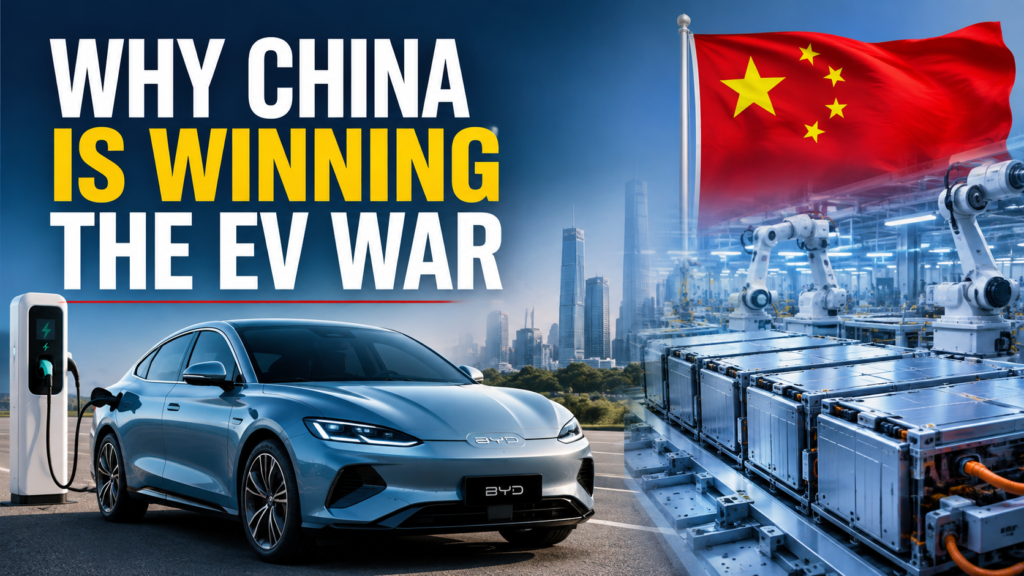
Electric vehicles are no longer a niche product. They are becoming the future of transportation. Around the world, governments and automakers are investing billions of dollars into electric cars as they try to reduce emissions and move away from fossil fuels.
Yet one country has pulled far ahead of the competition.
China.
Today, China dominates the global electric vehicle industry. Chinese companies sell millions of EVs every year, produce most of the world’s EV batteries, and control key parts of the supply chain needed to build electric cars.
The question is simple:
Why is China winning the EV war while countries like the United States and Europe struggle to keep up?
The answer comes down to long-term planning, government support, battery innovation, and supply chain control.
China’s EV Strategy Started Decades Ago
China’s success did not happen overnight.
More than 20 years ago, Chinese leaders saw two major problems:
- Growing dependence on imported oil
- Rising air pollution in major cities
At the same time, Chinese automakers were struggling to compete with established brands from Japan, Europe, and the United States.
Instead of trying to catch up in traditional gasoline-powered vehicles, China made a bold decision.
It would focus on electric vehicles.
The Chinese government began supporting what it called “new energy vehicles.”
This included electric cars, electric buses, and related battery technologies.
The goal was simple: create a new industry where China could become a global leader.
Massive Government Support Helped the Industry Grow
One of the biggest reasons China leads the EV market today is government investment.
For years, Chinese companies received support through:
- Tax breaks
- Research funding
- Consumer subsidies
- Cheap loans
- Low-cost land leases
According to estimates, China provided around $29 billion in support to its EV industry between 2009 and 2022.
Consumers also benefited.
People who bought electric cars often received financial incentives and other perks.
In many cities, EV owners enjoyed:
- Lower registration costs
- Easier parking
- Charging discounts
- Traffic-related benefits
These incentives encouraged millions of people to switch from gasoline vehicles to electric ones.
As demand increased, Chinese companies gained experience, expanded production, and lowered costs.
China Created Demand Before the Rest of the World
Many countries tried to build EV industries by supporting manufacturers.
China did something different.
It created demand first.
Local governments began replacing traditional buses and taxis with electric versions.
One famous example is Shenzhen.
The city converted its entire fleet of more than 16,000 buses to electric vehicles.
This provided companies with guaranteed customers and helped them scale production quickly.
As more electric vehicles appeared on the roads, public confidence grew.
Consumers became familiar with EV technology years before many other countries.
China Controls the EV Battery Supply Chain
The battery is the most expensive part of an electric vehicle.
In many cases, it accounts for around 40% of the total manufacturing cost.
This is where China’s biggest advantage exists.
Chinese companies control large portions of the global battery supply chain.
Electric vehicle batteries require several important minerals, including:
- Lithium
- Nickel
- Cobalt
- Graphite
- Manganese
Over the years, Chinese firms invested heavily in mining projects around the world.
But mining is only part of the story.
The real advantage comes after the minerals are extracted.
China dominates the refining process.
Refining turns raw materials into battery-grade minerals that can be used in manufacturing.
Today, China refines most of the world’s lithium and other critical battery materials.
This gives Chinese companies tremendous influence over battery production.
CATL Became the World’s Largest Battery Maker
When discussing EV batteries, one company stands above all others.
CATL (Contemporary Amperex Technology Co. Limited).
Based in China’s Fujian Province, CATL is now the world’s largest EV battery manufacturer.
Its batteries power vehicles from many major automakers.
CATL became successful because it focused on:
- Battery research
- Large-scale manufacturing
- Cost reduction
- Supply chain integration
As demand for electric vehicles increased, CATL expanded rapidly and became a key supplier for global car brands.
Today, many automakers depend on CATL technology to remain competitive.
Battery Innovation Changed Everything
For years, many electric vehicles used batteries containing nickel and cobalt.
These materials are expensive.
They also face supply challenges.
Chinese companies focused on improving an alternative battery technology called:
Lithium Iron Phosphate (LFP)
LFP batteries offer several advantages:
- Lower cost
- Better safety
- Longer lifespan
- Reduced reliance on expensive minerals
Companies such as CATL and BYD invested heavily in this technology.
The result was a major breakthrough.
LFP batteries became cheaper while delivering better performance.
This helped reduce EV production costs and made electric vehicles more affordable.
BYD Has Become a Global EV Giant
Another major success story is BYD.
The company originally produced batteries for electronics.
Over time, it expanded into electric vehicles.
Today, BYD is one of the world’s largest EV manufacturers.
Its success is closely linked to battery innovation.
BYD developed its own battery design known as the:
Blade Battery
The design improves safety and allows more battery cells to fit into the same space.
This helps increase driving range while keeping costs low.
As a result, BYD can offer electric vehicles that are often cheaper than competitors from Europe and North America.
Why American Automakers Are Struggling
Companies such as Ford and General Motors want to compete in the EV market.
However, they face several challenges.
First, battery costs remain high.
The average electric vehicle in the United States still costs significantly more than many gasoline-powered alternatives.
Second, the battery supply chain is heavily dependent on China.
Even when American automakers want to build affordable EVs, they often need Chinese technology or battery components.
Ford’s proposed battery plant using CATL technology became controversial because of concerns about China’s influence.
Yet many industry experts argue there are currently few alternatives.
China’s battery ecosystem is simply too advanced.
Can the United States Catch Up?
The United States is investing heavily in domestic battery production.
Government programs aim to encourage:
- New battery factories
- Mineral processing facilities
- Battery research
- Supply chain development
However, building an entire battery ecosystem takes time.
Experts estimate it could require tens of billions of dollars and many years of investment.
China spent decades building its current position.
Replicating that success will not happen overnight.
The Future of the EV Industry
The global EV race is far from over.
The United States, Europe, Japan, and South Korea continue investing in battery technology and electric vehicles.
At the same time, Chinese companies are expanding internationally.
Battery factories are already being built outside China, including in Europe and North America.
Competition will likely become even more intense over the next decade.
But for now, China remains the clear leader.
Final Thoughts
China is winning the EV war because it combined long-term planning, government support, manufacturing expertise, and battery innovation.
The country invested early when many others were still focused on traditional vehicles.
It built consumer demand, developed world-class battery companies, and secured control over critical parts of the supply chain.
The result is a powerful advantage that competitors are still trying to overcome.
Whether other countries can catch up remains uncertain.
What is clear is that the future of electric vehicles will be heavily influenced by decisions made in China.
As the world moves toward cleaner transportation, the battle for EV leadership is becoming one of the most important economic and technological competitions of the 21st century.